
Electro-Permanent Magnetic Chucks for CNC Milling: A Practical Buyer's Guide
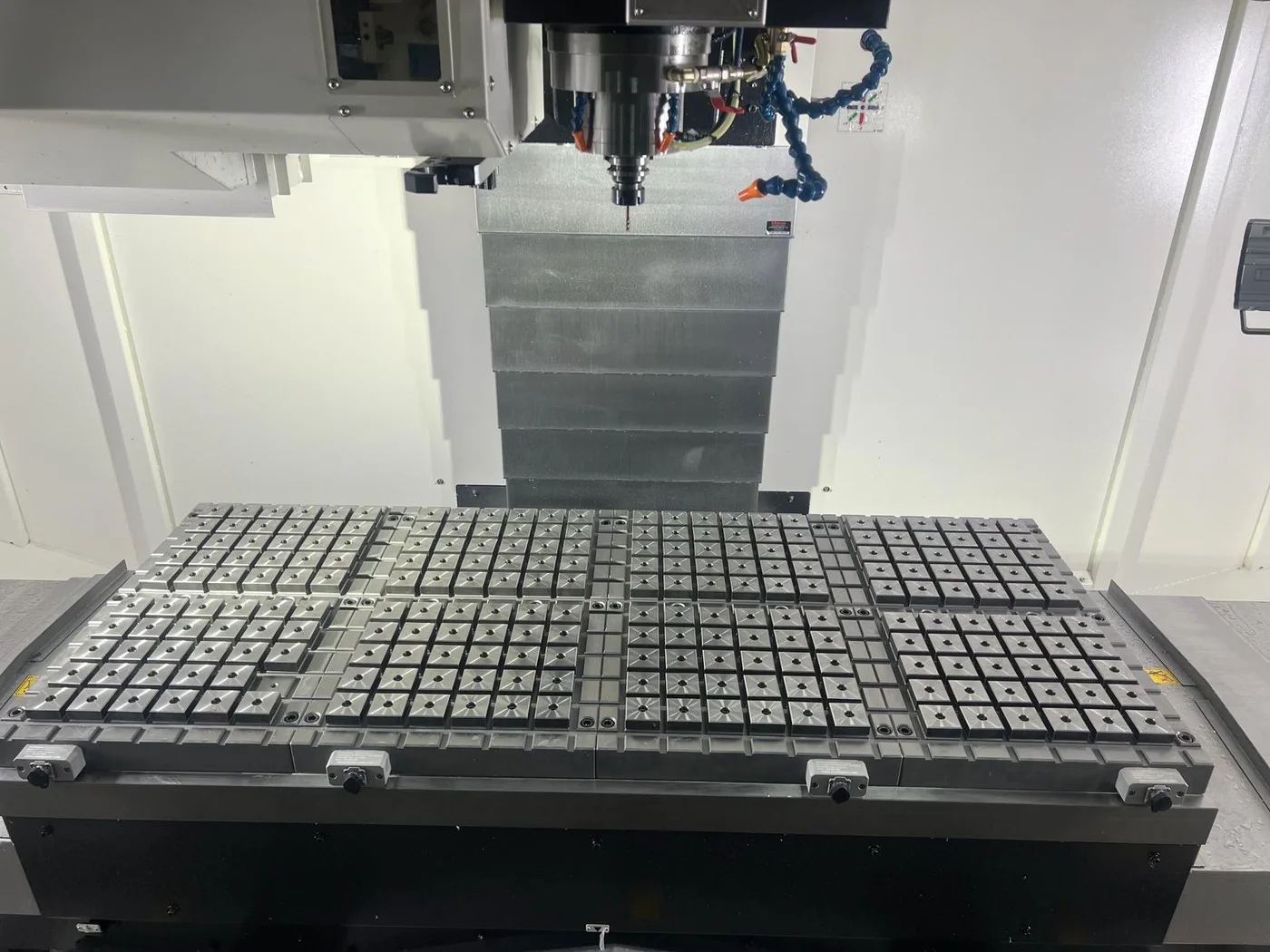
Workholding often slows down a CNC milling cell more than the spindle does. Setting up vises, tightening clamps, indicating fixtures and re-clamping for a second operation all eat into spindle time. An electro-permanent magnetic chuck (EPM chuck) can remove much of that work, but only when it suits the parts and is sized correctly.
This guide covers how EPM chucks work, where they beat other workholding, where they don't, and how to choose one. It is written for production managers, manufacturing engineers and buyers.
How an Electro-Permanent Magnetic Chuck Works
An EPM chuck contains permanent magnets, plus reversible magnets wrapped in coils. A short electrical pulse from the control unit reverses the polarity of the reversible magnets. That one change switches the chuck between two states:
- ON: magnetic flux flows out through the pole surface and into the workpiece, which holds the part down.
- OFF: the flux stays inside the chuck, so the surface is neutral and the part can be lifted off.
The chuck uses energy only during switching. Once it is ON, it holds the part with no continuous current. This has two practical results:
- The part stays clamped during a power cut, because the holding force comes from permanent magnets and not from a live electromagnet.
- The chuck doesn't heat up while clamping, which helps thermal stability on precision work.
An electromagnetic chuck works differently: it needs continuous power to hold, and it loses force when the power goes.
When an EPM Chuck Beats Vises and Fixtures
Five-face access in one setup. The part is held from below only, so the top and all four sides are open to the tool. Many parts that need two or three setups in a vise can be finished in a single setup on a magnetic chuck.
No clamping deformation. A vise squeezes the part from the sides. On thin plates and long parts, that pressure can distort the part, and the part can spring back after it is released. A magnetic chuck pulls the part evenly down onto a flat reference surface, which helps flatness and repeatability.
Setup in seconds. Place the part against stops and switch ON. No bolts or torque wrench are needed, and there is no need to build a dedicated fixture for each part number. This matters most in high-mix, low-volume production, mold bases, die plates and machine-builder components.
Repeatable accuracy. The part always sits on the same pole surface, so the reference stays the same from one setup to the next.
Know the Limits Before You Buy
Only ferromagnetic materials. Steel and cast iron clamp well. Aluminum, brass, copper, titanium, plastics and austenitic stainless steels do not. Some stainless grades hold only weakly. If most of your parts are non-ferrous, a magnetic chuck is not the answer.
Air gap is the biggest enemy. Holding force drops sharply as the gap between the part and the poles grows. Burrs, chips, scale, uneven saw-cut faces, warped plates and dirt all create an air gap. The rated holding force assumes full, clean contact. In practice:
- Deburr the contact face and keep the chuck surface clean.
- A pre-machined reference face gives the best result.
- Rough castings or flame-cut plates may need pole extensions or a facing operation first.
Part thickness. Thin parts cannot carry all the magnetic flux, so the effective holding force falls. Ask your supplier how force changes with part thickness for your actual parts.
Material and surface condition. Steel grade, heat treatment and surface roughness all affect how much flux the part can take. Hardened and alloyed steels usually hold less well than mild steel.
Lateral forces. Magnetic force acts mainly perpendicular to the chuck face. Side cutting forces are resisted mostly by friction. For heavy roughing, add mechanical stops or side support so the part cannot slide.
Not sure which chuck size fits your parts?
Send your part drawing and machine type — our engineers reply with a recommendation and a quote within 24 hours.
How to Size an EPM Chuck
Understand the pole layout. An EPM chuck face is a grid of north and south poles. Magnetic flux runs from one pole, through the part, into the next. A part must cover at least two poles (one north, one south) to clamp at all. More covered poles means more force and more stable holding.
For example, SN Magnet chucks use a 50x50 mm single pole. Each pole gives 25 cm² of clamping surface, so a model with 84 poles has 2100 cm² of clamping surface.
Estimate contact area. The nominal holding force of SN Magnet EPM chucks is 16 kgf/cm². Multiply that by the area of the part that actually touches the poles to get a theoretical maximum. Then reduce it for air gap, thickness, material and surface condition. Treat the nominal figure as a ceiling, not a guarantee.
Match the chuck to the machine and the part mix.
- Table size and T-slots: the chuck must fit and bolt down properly.
- Largest and smallest parts: small parts need enough pole coverage, and large parts need enough total area.
- Weight: check the machine table load limit with the chuck and part together.
- Several chucks or one large one: on long beds, a modular layout can be more flexible.
The free SNMagnet iOS app on the App Store helps estimate holding force and safety margins before you commit to a size.
What to Ask a Supplier
- What is the rated holding force, and under what conditions was it measured?
- What is the pole size and pole layout? Will your smallest part cover at least two poles?
- How is the chuck sealed? Coolant gets into everything. Many chucks are resin-filled, and resin can swell over time. SN Magnet uses a waterproof, resin-free construction to avoid this.
- What safety logic does the control unit use? On SN Magnet control units, the COM button must be pressed together with ON or OFF (two-hand logic). There is also a yellow-red 0/1 main switch and a push-lock table connector.
- What supply does it need? SN Magnet control units run on 380 VAC (L1-L2-PE, no neutral).
- Can you make custom sizes, and how fast?
- What is the warranty, and how is service handled abroad?
- Do you repair chucks from other brands? This is useful if you run a mixed fleet.
Why Consider a Magnetic Chuck Manufacturer in Turkey
- Short lead times: a nearby producer can turn custom work around quickly.
- Close to the EU: transit to European customers is short and logistics are well established.
- EU–Turkey customs union: it covers industrial goods, which generally makes trade with EU buyers simpler.
- Custom sizes: in-house design and production make non-standard dimensions practical.
- Competitive cost: strong engineering paired with a competitive cost base.
SN Magnet is the clamping-systems brand of Kesit Makine. Its engineering background goes back to 2008, and it has built magnetic clamping systems since 2019. Chucks are 100% made in Turkey at its own facility in İzmit, with mechanical, electronic and software components produced in-house. Custom sizes are delivered in 15-20 working days. Every chuck has a 2-year warranty and ships in wooden crates suited to international transport, and remote technical support is available. SN Magnet exports on demand to 25+ countries and is trusted by companies such as Toyota, Siemens, Sefine Shipyard, Eramold and ASELSAN. See the EPM magnetic chuck product page.
FAQ
Will the part come loose if the power fails? No. An EPM chuck holds with permanent magnets and uses power only to switch ON or OFF. The part stays clamped during a power cut.
Can I clamp aluminum or stainless steel? Aluminum, no. Many stainless grades, especially austenitic ones, also hold poorly or not at all. EPM chucks are designed for ferromagnetic materials such as steel and cast iron.
How small can a part be? It must cover at least two poles (one north, one south). With 50x50 mm poles, that sets a practical minimum footprint. Smaller parts may need pole extensions or a dedicated layout.
Does the chuck magnetize my parts? Some residual magnetism can remain, depending on the material. Ask your supplier about demagnetizing options if this matters downstream.
Can you repair a chuck from another manufacturer? Yes. SN Magnet offers brand-independent repair and service for magnetic chucks.